I went to see my old ceramics tutor from college to have a chat to him about my MA project. In a way, my MA project is a continuation of the work I did for the final project of my foundation course. During my final major project I explored the notion of using the sense of touch to experience ceramics and I looked at ways of adding texture to a ceramic object so that surface texture was just as important to the overall design of the finished piece as other aspects such as form, concept, glazing, material etc.
We talked about looking into the socio-political history of women and embroidery since I am looking to incorporate embroidery into my MA work. We also touched on 'what is art now?' Is a concept on its own enough or is a piece of work without a concept enough? We talked about Grayson Perry's attitude to contemporary art - that Duchamps started 'conceptual art' almost 100 years ago with his 'fountain sculpture' in 1917 and that Perry believes this idea to be out-dated now. In my opinion, I think that there has to be a concept behind a piece of work for it to be art. But for me, a concept isn't enough. I like to see a well produced and skillfully produced piece of art, whether it be a ceramic piece, a painting, a photograph, or a textile piece. I like to be able to admire the workmanship and skill that has gone into producing the work, as well as to appreciate the ideas and the concepts behind it.
I looked at a few videos on youtube about Richard Slee and Jeff Koons. Of particular note was the video of Grayson Perry interviewing Slee about his ceramic piece 'Sausage'. In it, Slee talks about the piece and what the concepts are behind it. He talked about it being a parody of the male maker and the death of the male DIYer.
I had my work in progress seminar in which I explained a little about what I had been doing up until now and I talked about what I had been doing so far for my MA. My fellow students seemed to like the two woven pieces that I showed them and the idea of using sense of touch to explore the pieces seemed to be greeted positively. They appreciated the tactility of the pieces and so I was pleased with that as this was my aim.
I got some interesting feedback - that my pieces were reminiscent of natural structures - wasps nests and birds nests, the fragility of birds eggs. The idea of wrapping around different objects such as parts of the body was also mentioned. The tutor Kerry mentioned how important the sense of touch was when designing ancient Egyptian art - 'haptic' meaning 'touch'. Irena also made the point that my pieces were very fragile and if someone used their sense of touch alone to experience them, they may not survive since the 'viewer' would have no concept of how fragile they were. I think that this was a fair point to make and one worth bearing in mind for future work.
Vanda also made the point that the coloured metallic oxides that I had used on the first piece added nothing to the end result as the matt porcelain was beautiful on its own and the use of colour only distracted the eye from the pureness of the porcelain.
I think it is important to get feedback on work from your peergroup as it can help to get fresh ideas for future work and it helps to see whether the work is getting the reaction that you wanted it to have. Does it fulfill the requirements or is it slightly off the mark?
Wednesday, 4 January 2012

Tuesday, 3 January 2012
Bone China and fabric
I built up two other bowls using the same method as before but using liquid bone china instead of porcelain slip. I wanted to compare the qualities of the bone china and porcelain. In theory the two types of clay are very similar.
Porcelain is fine in texture and white and tough when fired. It can be either opaque or translucent. It is notoriously difficult to handle as it has a critical moisture range to it can easily be too soft or dry to handle. It fires to 1280-1300'c.
Bone china is prepared with special characteristics of thinness, translucency, whiteness and extreme strength. Calcined bone is added which acts like a flux to the clay body making it fuse into a tough glass-like substance at temperatures above 1240'c. It has a poor mechanical strength before firing and a limited top firing range after which it quickly loses it's shape and collapses. Because of its smoothness and whiteness it is very well suited to fine decoration. In the 1980's, the ceramicist Angela Verdon made interesting slipcast pierced and scratched forms from bone china:


I used the same method to weave thin strips of different fabric that had been immersed in bone china slip around a balloon:

This photo was taken after the slip had dried but before firing. I stitched a strip of organza with embroidery thread using chain stitch. I used organza because it doesn't absorb the slip very well (being man-made) whereas the stitches should work well. I wanted to make the stitches stand out visually so I painted copper oxide mixed with bone china slip onto the thread. This appears black in the above photo.


This structure is incredibly delicate, perhaps more so than those in porcelain. However, this could be because I built it more delicately than those built in porcelain. I did like how the copper oxide accentuated the chain stitch however. I think that the structure has warped just as much as the porcelain but the amount of warpage will depend on the height of the structure I guess. At the moment I am learning about the materials and what happens if I do such and such to it.
I built a second piece with bone china using some fleece material so that hopefully the structure will be a little stronger:


Porcelain is fine in texture and white and tough when fired. It can be either opaque or translucent. It is notoriously difficult to handle as it has a critical moisture range to it can easily be too soft or dry to handle. It fires to 1280-1300'c.
Bone china is prepared with special characteristics of thinness, translucency, whiteness and extreme strength. Calcined bone is added which acts like a flux to the clay body making it fuse into a tough glass-like substance at temperatures above 1240'c. It has a poor mechanical strength before firing and a limited top firing range after which it quickly loses it's shape and collapses. Because of its smoothness and whiteness it is very well suited to fine decoration. In the 1980's, the ceramicist Angela Verdon made interesting slipcast pierced and scratched forms from bone china:

Angela Verdon 1980 Porcelain

Angela Verdon 'Paper Thin Porcelain Vase
I used the same method to weave thin strips of different fabric that had been immersed in bone china slip around a balloon:

This photo was taken after the slip had dried but before firing. I stitched a strip of organza with embroidery thread using chain stitch. I used organza because it doesn't absorb the slip very well (being man-made) whereas the stitches should work well. I wanted to make the stitches stand out visually so I painted copper oxide mixed with bone china slip onto the thread. This appears black in the above photo.


This structure is incredibly delicate, perhaps more so than those in porcelain. However, this could be because I built it more delicately than those built in porcelain. I did like how the copper oxide accentuated the chain stitch however. I think that the structure has warped just as much as the porcelain but the amount of warpage will depend on the height of the structure I guess. At the moment I am learning about the materials and what happens if I do such and such to it.
I built a second piece with bone china using some fleece material so that hopefully the structure will be a little stronger:

I also used the shaggy wool as I really like the tactile quality of this when it is fired. I stitched a long strip of organza with emroidery thread and chain stitch as above but I have added more copper oxide to it. I hope I haven't overdone it but I wanted to accentuate the light and dark parts of the structure - where the fabric strips cover others so creating shadow and lighter sections etc. The piece was left to dry over the Christmas holidays and will hopefully be fired next week.

Wednesday, 28 December 2011
Howard Risetti, A theory of craft: function and aesthetic expression
I included Howard Risetti's book 'A theory of craft: function and aesthetic expression' in my annotated bibliography because it was of interest and of relevance to me. Within the book Risetti talks about the importance of craft and how craft must find a niche for itself that is neither fine art, nor design, but something separate and unique, but of the same importance within the umbrella of the visual arts. Otherwise, the importance of the crafts will be lost. It's an interesting subject since ceramics sits under the umbrella of the crafts or applied arts.
Risetti doesn't like the term 'applied arts' since, for him the term has connotations with something that is machine made. I am comfortable with the term since it is used widely within educational instiutions to describe the arts where something with a purpose is made, i.e. ceramics, textiles, jewellry, 3d. But there are other types of craft aswell, since people who build dry stone walls, who make lace, who make cricket bats (and many other craftspeople)are also practising a craft, are they not? Then there are those who 'craft' at home and do things like glass painting or scrapbooking. This is something altogether different. I think the term 'craft' when talking about the applied arts is too simplistic.
Indeed, Grayson Perry said that craft is something that can be taught by a skilled craftsperson to someone else, whereas art can not be taught but is something inherant within the artist. Although Perry is a potter, to me he is a fine artist, the only difference is he is using ceramics as his medium or canvas on which he chooses to comment on contemporary issues relevant to todays society.
I think it is too simplistic to assume that a work of art must be either craft or fine art. Risatti asserts that the main function of the fine arts is to communicate certain ideas or concepts and that the main purpose of craft is to serve the physiological needs of the body. But an artist can work with traditional craft materials whilst communicating the concepts behind the work. Artists are continually exploring new materials to communicate their ideas. Love him or loathe him, Perry has done a lot to 'sell' the benefits that ceramics has to offer the visual arts. For me, as well as being a fine artist, Perry is also a craftsman since he has spent years perfecting his craft and he executes his pots (and textiles) with a lot of technical expertise. Tracey Emin is an another example of a contemporary artist working with traditional craft materials (textiles).
But is it important where the crafts/the applied arts sit in terms of the visual arts? Of course it does since paintings command a lot more money than ceramics or other applied arts. In his book 'Painted Clay: Graphic Arts and the Ceramic Surface', Paul Scott asserts that the material an artwork is made from will determine its value within the visual arts field. He used the example of how well the exhibition of Picasso’s ceramics held at the Royal Academy was received in London in 1998. He quotes the journalist Adrian Searle from ‘The Guardian’ who cited Norman Rosenthal, exhibition secretary for the Academy at the time that there had been a lot of resistance to the very idea of the ceramics show, referring to Picasso and his ceramic work as ‘kitsch.’
It's an interesting debate though...
Incidentally, I went to see the 'Power of Making' exhibition at the V&A. It was an interesting collection and it showed the breadth and depth that crafts still have today.
Risetti doesn't like the term 'applied arts' since, for him the term has connotations with something that is machine made. I am comfortable with the term since it is used widely within educational instiutions to describe the arts where something with a purpose is made, i.e. ceramics, textiles, jewellry, 3d. But there are other types of craft aswell, since people who build dry stone walls, who make lace, who make cricket bats (and many other craftspeople)are also practising a craft, are they not? Then there are those who 'craft' at home and do things like glass painting or scrapbooking. This is something altogether different. I think the term 'craft' when talking about the applied arts is too simplistic.
Indeed, Grayson Perry said that craft is something that can be taught by a skilled craftsperson to someone else, whereas art can not be taught but is something inherant within the artist. Although Perry is a potter, to me he is a fine artist, the only difference is he is using ceramics as his medium or canvas on which he chooses to comment on contemporary issues relevant to todays society.
I think it is too simplistic to assume that a work of art must be either craft or fine art. Risatti asserts that the main function of the fine arts is to communicate certain ideas or concepts and that the main purpose of craft is to serve the physiological needs of the body. But an artist can work with traditional craft materials whilst communicating the concepts behind the work. Artists are continually exploring new materials to communicate their ideas. Love him or loathe him, Perry has done a lot to 'sell' the benefits that ceramics has to offer the visual arts. For me, as well as being a fine artist, Perry is also a craftsman since he has spent years perfecting his craft and he executes his pots (and textiles) with a lot of technical expertise. Tracey Emin is an another example of a contemporary artist working with traditional craft materials (textiles).
But is it important where the crafts/the applied arts sit in terms of the visual arts? Of course it does since paintings command a lot more money than ceramics or other applied arts. In his book 'Painted Clay: Graphic Arts and the Ceramic Surface', Paul Scott asserts that the material an artwork is made from will determine its value within the visual arts field. He used the example of how well the exhibition of Picasso’s ceramics held at the Royal Academy was received in London in 1998. He quotes the journalist Adrian Searle from ‘The Guardian’ who cited Norman Rosenthal, exhibition secretary for the Academy at the time that there had been a lot of resistance to the very idea of the ceramics show, referring to Picasso and his ceramic work as ‘kitsch.’
It's an interesting debate though...
Incidentally, I went to see the 'Power of Making' exhibition at the V&A. It was an interesting collection and it showed the breadth and depth that crafts still have today.
Monday, 19 December 2011
Second porcelain test piece
The second porcelain test piece came out of the kiln in tact. Although the form has slumped quite a bit in the kiln. As such, it is no longer round but oval and it has folded in on itself slightly. I like the non-uniform shape of it. It is still very fragile.


Second porcelain test piece after stoneware firing
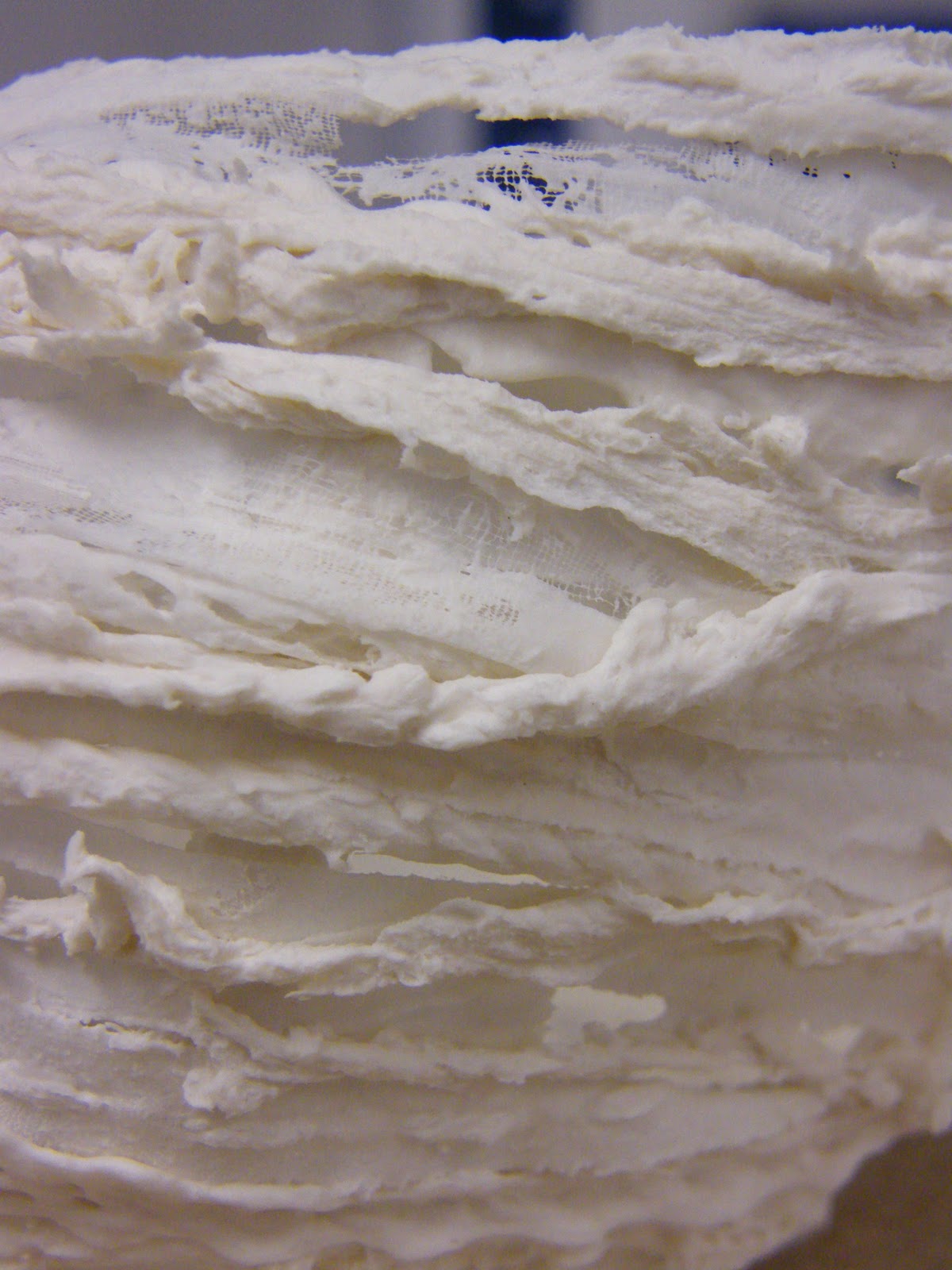
As with the first test piece, the porcelain has taken the form of the various fabrics very well on the whole. Though the organza hasn't worked as well because it has resisted the porcelain in places. This can be seen at the top of the above close-up photo. Also evident is the stitched cotton fabric where I incorporated a running stitch through the fabric strip. This has also come out quite well.
Wednesday, 14 December 2011
Photos from my dog walks!
I often take my camera with me when I take my dog for a walk in the woods near to where we live. I generally take lots of photos in the hope that they will inspire future work projects. I love finding small details and capturing them on camera. I took these shots one sunny Autumn morning:


Then a few days ago I was out early and could see lots of spiders webs, normally invisible but today displayed for all to see due to the early morning dew:


I really like the fragility and beautiful structure of spider's webs. They are something from nature that we take for granted and are easily passed by as we carry on with our busy lives. The fragilility of the structures remind me of the delicate structures I am producing at the moment with fabric and porcelain slip.

I thought this funghi particularly beautiful and I liked the velvety texture

I really liked the array of colours displayed on this rusty fence post

Here, I liked how the wire was wrapped around the fence post
Then a few days ago I was out early and could see lots of spiders webs, normally invisible but today displayed for all to see due to the early morning dew:


I really like the fragility and beautiful structure of spider's webs. They are something from nature that we take for granted and are easily passed by as we carry on with our busy lives. The fragilility of the structures remind me of the delicate structures I am producing at the moment with fabric and porcelain slip.
Fabric and porcelain slip
Following on from my first test piece with fabric and porcelain slip I looked for materials at home with texture that I could cast with porcelain. I found some cotton yarn that looks embroidered and some wool with a shaggy texture. I also found some organza and wanted to see how that would turn out, since it is not cotton, I expected it to work less well and repel some of the porcelain. I was also keen to stitch onto strips of fabric and incorporate that.


Second Porcelain Test Piece formed around a balloon

Close-up photo showing the different materials used including cotton'embroidered' yarn, 'shaggy' yarn, fabric stitched with a running stitch
I also used thin strips of cotton fabric, wide cotton string and organza. Once the fabric had been left to dry for a few days, I carefully popped the balloon:

On the shelf waiting to be fired

I decided not to glaze the piece, but to see how the porcelain would be in it's natural, unglazed state. As such, I left it to be fired to stoneware temperature.
Monday, 12 December 2011
Stitching and porcelain
I decided to try a few embroidery stitches from my Mum's book '100 Embroidery Stitches'.

I tried a stem stitch and a laced running stitch.

Stem Stitch

Laced Running Stitch
I then immersed the fabric into porcelain slip:

Once dry the fabric was fired to stoneware temperature. It survived the kiln but is very brittle and fragile. It has come out quite well and the stitches are evident though subtle when touched.


I think this is a nice way of working though I think that texture is achieved better through wrapping strips of fabric around a form. Food for thought though...
Sunday, 11 December 2011
Ponderings on embroidery threads, clay and tactile diagrams
My Mum has given me a beautiful box of embrioidery threads that belonged to her and her Mum:

My Grandmother was a talented embroiderer, as were many women in her day. She also made lace, decorated cakes, everything hand crafted. My Mum is unwell now but she was a talented dressmaker when she was younger, making beautiful clothes for herself and for me when I was a child. She was also very good at knitting, a skill which she taught me when I was a teenager.
Anyway, back to the box of threads. My Mum has also given me a lovely book printed in 1959 entitled '100 Embroidery Stitches'. I think that the threads and book could tie into my work with textiles and clay. I am very interested in creating ceramics that can be explored with touch. So I am going to try stitching fabric with embroidery stitches and casting that into clay to see how the stitches look and feel when cast in porcelain. I am keen to teach myself a few of the stitches in the book. I like the fact that I'd be using an object of sentimental value - I don't embroider, but it would be nice to incorporate it into my own work. It's a way of recycling materials, of using something that belonged to my Mum, of creating surface texture, perhaps like a form of braille...
When I researched visual impairments for my FMP for my foundation, I came across museum programmes for the blind or visually impaired. The non-profit organisation 'Art Education for the Blind' has produced an art history training programme for the blind and the visually impaired. Amongst the tools used is a tactile diagram to feel examples of art works. Some works of art are complex and therefore the AEB have developed several different types of raised patterns to fully describe compositional and stylistic details:


I think this work is very interesting and I am wondering if I can use this idea in my work.

My Grandmother was a talented embroiderer, as were many women in her day. She also made lace, decorated cakes, everything hand crafted. My Mum is unwell now but she was a talented dressmaker when she was younger, making beautiful clothes for herself and for me when I was a child. She was also very good at knitting, a skill which she taught me when I was a teenager.
Anyway, back to the box of threads. My Mum has also given me a lovely book printed in 1959 entitled '100 Embroidery Stitches'. I think that the threads and book could tie into my work with textiles and clay. I am very interested in creating ceramics that can be explored with touch. So I am going to try stitching fabric with embroidery stitches and casting that into clay to see how the stitches look and feel when cast in porcelain. I am keen to teach myself a few of the stitches in the book. I like the fact that I'd be using an object of sentimental value - I don't embroider, but it would be nice to incorporate it into my own work. It's a way of recycling materials, of using something that belonged to my Mum, of creating surface texture, perhaps like a form of braille...
When I researched visual impairments for my FMP for my foundation, I came across museum programmes for the blind or visually impaired. The non-profit organisation 'Art Education for the Blind' has produced an art history training programme for the blind and the visually impaired. Amongst the tools used is a tactile diagram to feel examples of art works. Some works of art are complex and therefore the AEB have developed several different types of raised patterns to fully describe compositional and stylistic details:

The various patterns used by the AEB for their tactile diagrams

The image on the right is the AEB's tactile version of Michealangelo's painting 'Creation of Adam' pictured on the left.
I think this work is very interesting and I am wondering if I can use this idea in my work.
Saturday, 10 December 2011
Grayson Perry Exhibition
I went to see the Grayson Perry exhibition 'The Tomb of the Unknown Craftsman' last week at the British Museum. I thought it was excellent and a real celebration of craftspeople through the ages, to the present day. I like to see pieces that are well made and skillfully put together. This exhibition contains both. As Grayson says ' The Tomb of the Unknown Craftsman is a memorial to makers and builders, all those countless un-named skilled individuals who have made the beautiful man-made wonders of history..'
I also really like the quote by the polymath Jacob Bronowski (I found out something new today - a polymath is someone who is an expert in several fields. Leonardo de Vinci was also a polymath) Anyway, Bronowski said 'The most powerful drive in the ascent of man is his pleasure in his own skill. He loves to do what he does well and, having doen it well, he loves to do it better. You see it in his science. You see it in the magnificence with which he carves and builds, the loving care, the gaiety, the effrontery. The monuments are supposed to commemorate kings and religions, heroes, dogmas, but in the end, the man they commemmorate is the builder.'
The exibition is a combination of Perry's latest work and artefacts from the British Museum's vast collections. In some instances it is difficult to work out which is Perry's work and which belong to the BM. Two helmets are of particular note here. The one I thought that was made by Perry was in fact a Ceremonial headdress from Ghana (19th century) and the helmet which I thought looked ancient was in fact made by Perry in 1981:


P.S. Have just read Brian Sewell's review of this exhibition. Why did I do it when I know he is a dinosaur and is obviously out of touch with Contemporary Art if he thinks that pots can't be 'art' grrrr! I don't think I have read one review of his that has been positive.
I also really like the quote by the polymath Jacob Bronowski (I found out something new today - a polymath is someone who is an expert in several fields. Leonardo de Vinci was also a polymath) Anyway, Bronowski said 'The most powerful drive in the ascent of man is his pleasure in his own skill. He loves to do what he does well and, having doen it well, he loves to do it better. You see it in his science. You see it in the magnificence with which he carves and builds, the loving care, the gaiety, the effrontery. The monuments are supposed to commemorate kings and religions, heroes, dogmas, but in the end, the man they commemmorate is the builder.'
The exibition is a combination of Perry's latest work and artefacts from the British Museum's vast collections. In some instances it is difficult to work out which is Perry's work and which belong to the BM. Two helmets are of particular note here. The one I thought that was made by Perry was in fact a Ceremonial headdress from Ghana (19th century) and the helmet which I thought looked ancient was in fact made by Perry in 1981:
Ceremonial headress, Asante, Ghana (19th century)

Grayson Perry 'Early English Motorcycle Helmet' 1981 (Aluminium)
Grayson Perry's pots are amazingly crafted and detailed. The decals and images drawn directly onto the clay are skillfully thought out and placed with precision onto the surface. But they aren't just pots, they are comments on aspects of our current culture and society.

The Rosetta Vase (detail) Grayson Perry, 2011
His work is incredibly detailed and thought out. As well as his pots, I really liked his cast iron work which was cast in an iron foundry by craftspeople that Perry acknowledges in his exhibition guide. Again, the work is highly detailed such as 'Our Mother' shown below:
Our Mother, Grayson Perry, 2009
So all hail to Grayson Perry! His work is amazing, but I also agree with his thoughts on contemporary art. The notion that art isn't special enough anymore, that the concept has become more important than the art itself, or even that there only has to be a concept and no art. I think there has to be both, without concepts and ideas behind a work of art, then it is just a hobby, or something to look nice on a wall at home. But neither do I agree with the notion that a concept is enough. Duchamp submitted his 'Fountain' sculpture nearly 100 years ago and I agree with Grayson Perry when he says that the idea is worn out and dated. Perry's work is both thought-provoking and skillfully made. I think his work is special and when I look at it I think 'I couldn't do that, nor could I come up with the idea for it'. For me, that's what great art is.
Monday, 5 December 2011
Textiles and Clay cont.
After bisquet firing, the ceramic piece looked like this. The blue parts have been painted with cobalt oxide stain and the green parts with copper oxide:


The ceramic piece after bisquet firing

After bisquet firing (detail)
The ceramic piece held it's shape well during bisquet firing and the metallic oxides have changed colour. The piece is still powdery and will be very fragile until it is fired to stoneware tempereature (1280'c). I dripped translucent glaze onto parts of the surface so I could compare the qualities of the matt and glossy surfaces. The piece was then fired to stoneware temperature and the finished piece looks like this:

Glazed and finished piece

Glazed and finished piece (detail)
On the whole I was very pleased with how this piece came out. The form changed slightly in the kiln and became more of an oval shape. I like this as the form is more interesting now and the piece has taken on it's own shape. The metallic oxides also came out well and provide a nice contrast with the whiteness of the porcelain. I particularly like how the lace ended up and it worked better than I expected. The fragility of the lace is clearly visible in places, accentuated by the copper oxide. There are also interesting contrasts between the glazed and unglazed parts of the plain porcelain. In a way, the glassy surface that the glaze has covered dilutes and mutes the texture of the fabric. I think that the unglazed parts are much more interesting and have more depth. This way of working definately allows me to create lots of surface texture, and I really like this.
Subscribe to:
Posts (Atom)